Meet the Founder: Henry Bilinsky
Inventor, Polymath, Founder
Ground Floor Lore
Forged deep within the compressor of a Pratt & Whitney J58, Henry is said to have received the divine revelation for MicroTau in a vision from Wilbur Wright himself.
OK, not really. Henry’s real story may not be dripping with quite as much aerospace prestige as this, but he has managed to fuse sharks and lasers into the technology behind an aerospace efficiency product with the potential to be massively transformative in civil and defense aviation. We think that’s pretty cool.
One specific key insight led to the invention of this technology and MicroTau’s foundation; not a bolt from the blue, but the culmination of a sequence of well-placed steps, creating a roadmap to deep tech success.

Image: Henry demonstrates his ‘seeing the vision for the future’ face
Education, Intersection, & Revelation
Henry holds two (2) degrees. The first is a Bachelor of Science (Advanced) from the University of Sydney, where his final year concluded with a project to build a nuclear reactor with scrap parts that actually achieved fusion. He then went on to complete a Juris Doctor and was admitted as a lawyer of the Supreme Court of New South Wales.
With physics and law degrees in hand, Henry's thinking turned to how these fields could intersect. He found the answer in intellectual property. In identifying that patent offices effectively catalogued solutions to highly specialised problems, Henry formed the thesis that solutions for narrow problems sets could likely also be applied to other industries, but domain-specific knowledge and terminology often prevented these solutions from being applied more broadly.
Opportunity & Ingenuity
While still being admitted as a lawyer, Henry saw an opportunity to apply this thesis to an online open challenge posted by the US Air Force Research Laboratory seeking methods to reduce the enormous fuel bill of their legacy transport aircraft. Henry saw that photolithography - the manufacturing technology used to fabricate computer chips - could also be used to fabricate the microscopic drag-reducing 'riblet' structures found in shark skin. Where a semiconductor fabricator would apply a patterned ultraviolet light to a photoresist layer on a silicon wafer substrate, Henry would expose the photoresist layer to a riblet-patterned light field such that it could be then applied to aircraft. Henry called this process Direct Contactless Microfabrication, or DCM.
Henry’s whitepaper submission to the US Air Force was successful, and he built a prototype DCM processing rig to print the first photolithographic riblets. While today’s DCM processing rigs are optically advanced, Henry’s original prototype employed laser diodes from Blu-ray players bought on eBay to demonstrate DCM’s working principles. Nevertheless, shark skin printed with this early configuration exceeded performance expectations when tested in Lockheed Martin’s wind tunnels.
The potential economic and environmental impact of this technology was clear to polymaths and non-polymaths alike. The same shark skin technology that could reduce the fuel burn of the US Air Force’s transport aircraft could also be applied to the commercial airlines, which together burn US$261 billion on fuel every year. With cost of fuel the single largest operating expense, 4% savings here translate to a 25% increase to airline profit margins and CO2 emissions reduction summing to the millions of tonnes globally every year.

Image: Henry accepts People’s Choice Award at AmCham Alliance Awards Gala 2025.
📸: American Chamber of Commerce in Australia
Ambition, Mission, & Vision
In 2023, Henry, supported by MicroTau’s senior leadership team, pitched a shark skin flight test program to the US Air Force and was selected over industry juggernauts including the world’s largest defense primes and market incumbents. MicroTau has seen numerous breakthroughs under Henry’s leadership, having achieved order-of-magnitude improvements in manufacturing throughput and securing pre-orders from some of the world’s largest airlines.
Today, MicroTau numbers nearly 40 manufacturing engineers, material scientists, product engineers, aeronautical engineers, and business operations specialists, all sharing the singular focus to improve the efficiency of the global aviation industry. The team has collectively achieved a number of world-firsts, including the first flight test of shark skin ‘riblet’ surfaces on US Air Force aircraft and the first riblet flight tests beyond Mach 1 on Boom Supersonic’s XB-1.
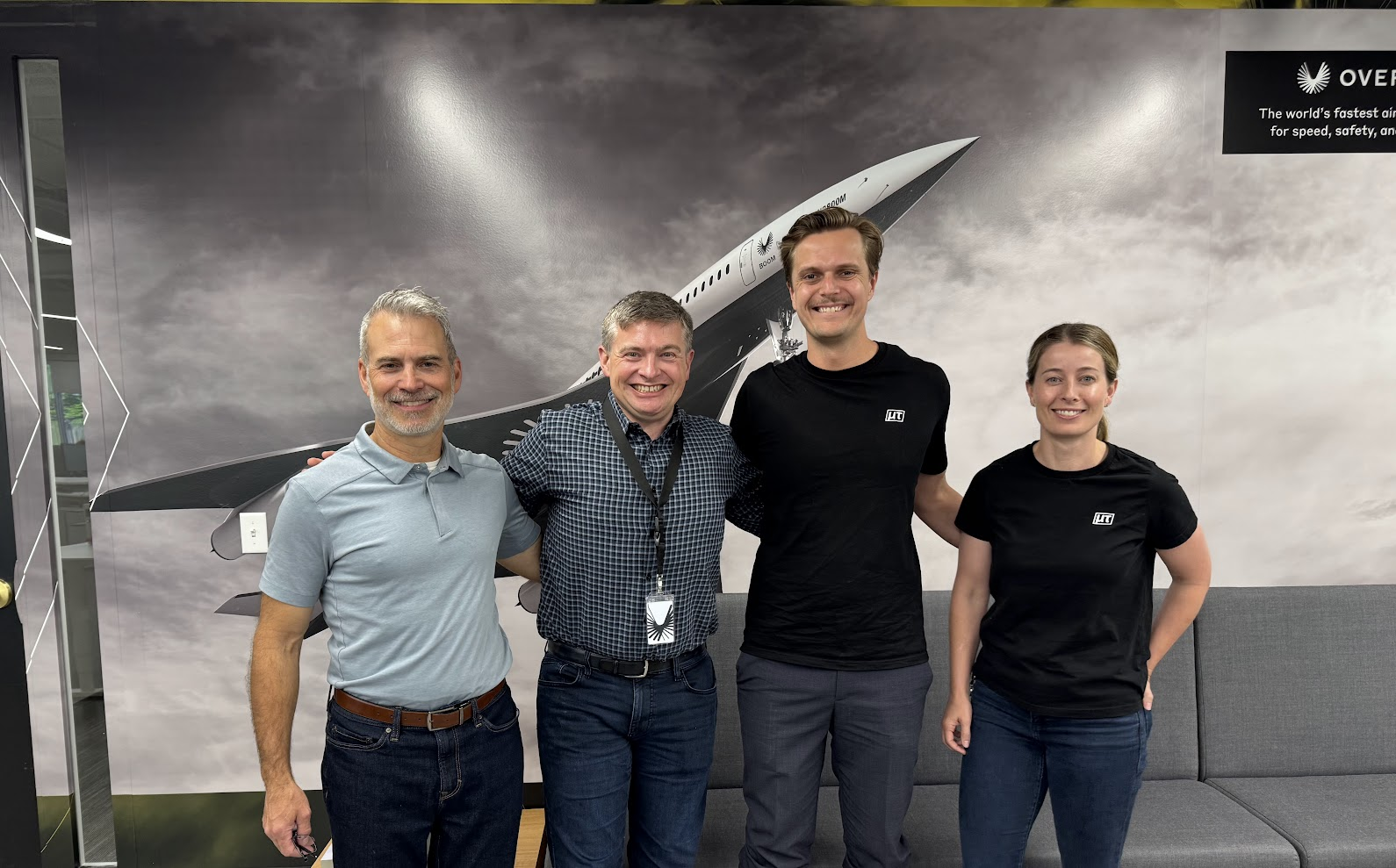
Image: Henry and MicroTau COO Candice Berger (right) with Boom Supersonic CEO Blake Scholl (middle left) and SVP of Programs, Jeff “Legs” Mabry (left)
Henry’s vision for the future is one where energy wasted on overcoming friction drag is a thing of the past.
“I want to get this flying on as many planes as possible. Then it's every surface that moves in a fluid - marine, energy, flight to space - we can make it all more efficient.”